
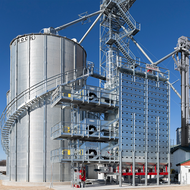
Grain Dryer Types for Corn Farming Operations
Published by The Grain Handling Direct Team - Powered by AI on Apr 25th 2025
This comprehensive analysis examines the strengths and weaknesses of four major types of grain dryers in agriculture: mixed flow dryers, portable grain dryers, in-bin drying systems, and tower dryers. The analysis focuses specifically on their suitability for corn farming operations in the Upper Midwest climate of the United States and Canada, with particular emphasis on energy efficiency, cost considerations, and maintenance requirements.
Each dryer type offers distinct advantages and disadvantages, with their optimal application varying based on operation size, financial considerations, existing infrastructure, management style, and local support availability. This document provides corn farmers with the information needed to make informed decisions about which grain drying system provides the best value for their specific operations.
Introduction and Methodology
This analysis was conducted through extensive research of technical specifications, manufacturer information, agricultural extension publications, and real-world user experiences. The research methodology included:
- Detailed examination of operational principles for each dryer type
- Analysis of energy efficiency factors and performance metrics
- Evaluation of initial investment and operating costs
- Assessment of maintenance requirements and brand performance differences
- Collection of user feedback from farming forums and social media
- Comparative analysis across multiple factors relevant to corn farming in the Upper Midwest
The findings are presented in a structured format that allows for direct comparison between dryer types while acknowledging that the "best" solution depends on the specific circumstances of each farming operation.
Decision Framework for Farmers
When selecting among grain dryer types, farmers should consider the following factors:
Operation Size
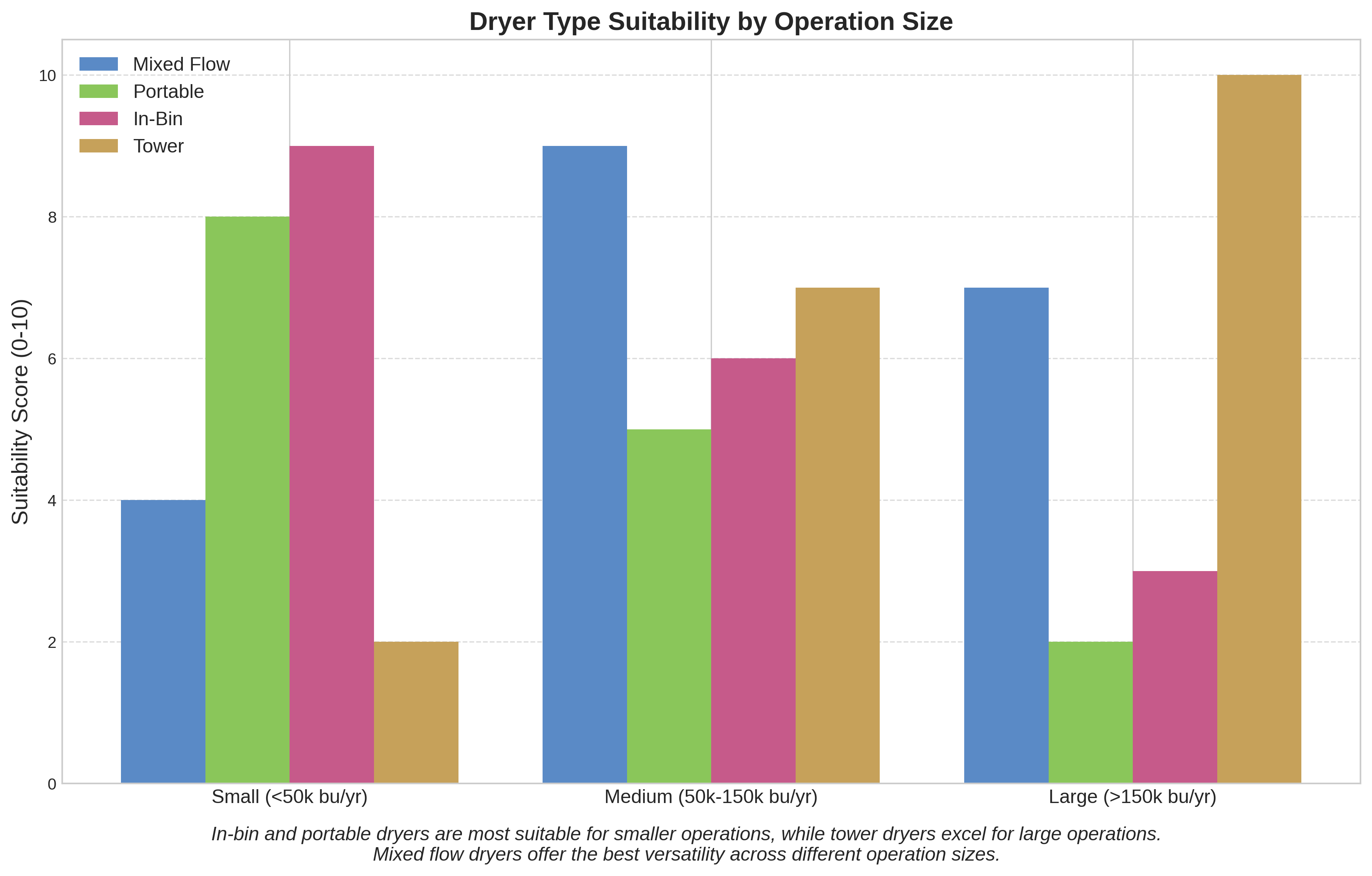
- Small operations (<50,000 bushels annually): Consider portable dryers or in-bin systems.
- Medium operations (50,000-150,000 bushels): Consider mixed flow dryers, Shivvers systems, or multiple in-bin systems.
- Large operations (>150,000 bushels): Consider tower dryers or multiple mixed flow dryers.
Financial Considerations
- Limited capital: Portable dryers or conventional in-bin systems offer lowest initial investment.
- Focus on operating costs: In-bin systems (conventional or Shivvers) offer lowest long-term operating costs.
- Return on investment: Consider service life and resale value; mixed flow and tower dryers typically maintain value better.
Existing Infrastructure
- Limited electrical service: Portable dryers may be preferable as they often require less electrical capacity.
- Existing bins: Adding in-bin drying capability to existing grain storage systems may be cost-effective.
- Limited space: Tower dryers offer maximum capacity in minimal footprint.
Management Style
- Hands-on operators: May prefer the simplicity of portable or in-bin systems.
- Technology-focused: May prefer the automation of mixed flow, Shivvers, or tower dryers.
- Risk-averse: May prefer the weather independence of high-capacity systems like tower or mixed flow dryers.
Local Support
- Dealer proximity: Consider local dealer support for parts and service.
- Brand prevalence: More common brands in the region typically have better parts availability.
- Service technicians: Availability of qualified service technicians for more complex systems.
Dryer Type 1: Mixed Flow Grain Dryers
General Principles and Operation
Mixed flow dryers represent a significant advancement in grain drying technology, combining elements of cross-flow and concurrent-flow designs. In these systems, grain flows vertically downward through the dryer while air moves both horizontally and vertically through the grain column in a mixed-flow pattern.
The key operational components include:
- A series of alternating air supply and exhaust ducts arranged to create a mixed airflow.
- Grain columns typically 12-16 inches thick for optimal air penetration.
- Metering rolls at the bottom to control grain flow rate.
- Multiple heating zones with independent temperature control.
- Cooling section in the lower portion of many models.
The mixed airflow pattern ensures more uniform moisture removal and reduced thermal stress. This allows for higher drying temperatures without compromising grain quality.
Energy Efficiency Factors
- Multiple air passes: The mixed flow pattern extracts more moisture per unit of energy.
- Heat recovery systems: Modern units capture and reuse heat from the cooling section.
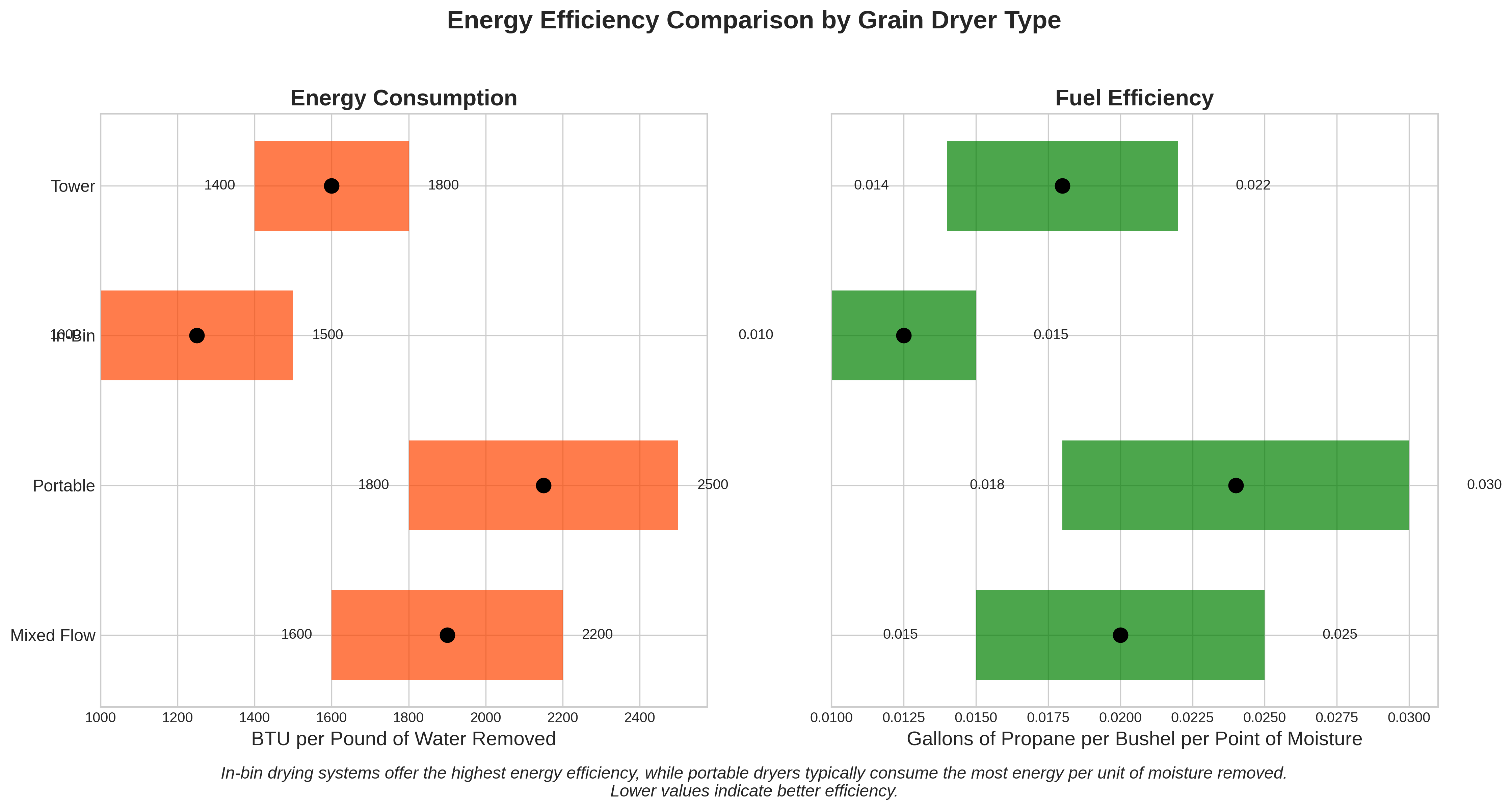
Mixed flow dryers typically use 1,600-2,200 BTU per pound of water removed, representing a 15-25% improvement over conventional designs.
Cost Considerations
Initial Investment
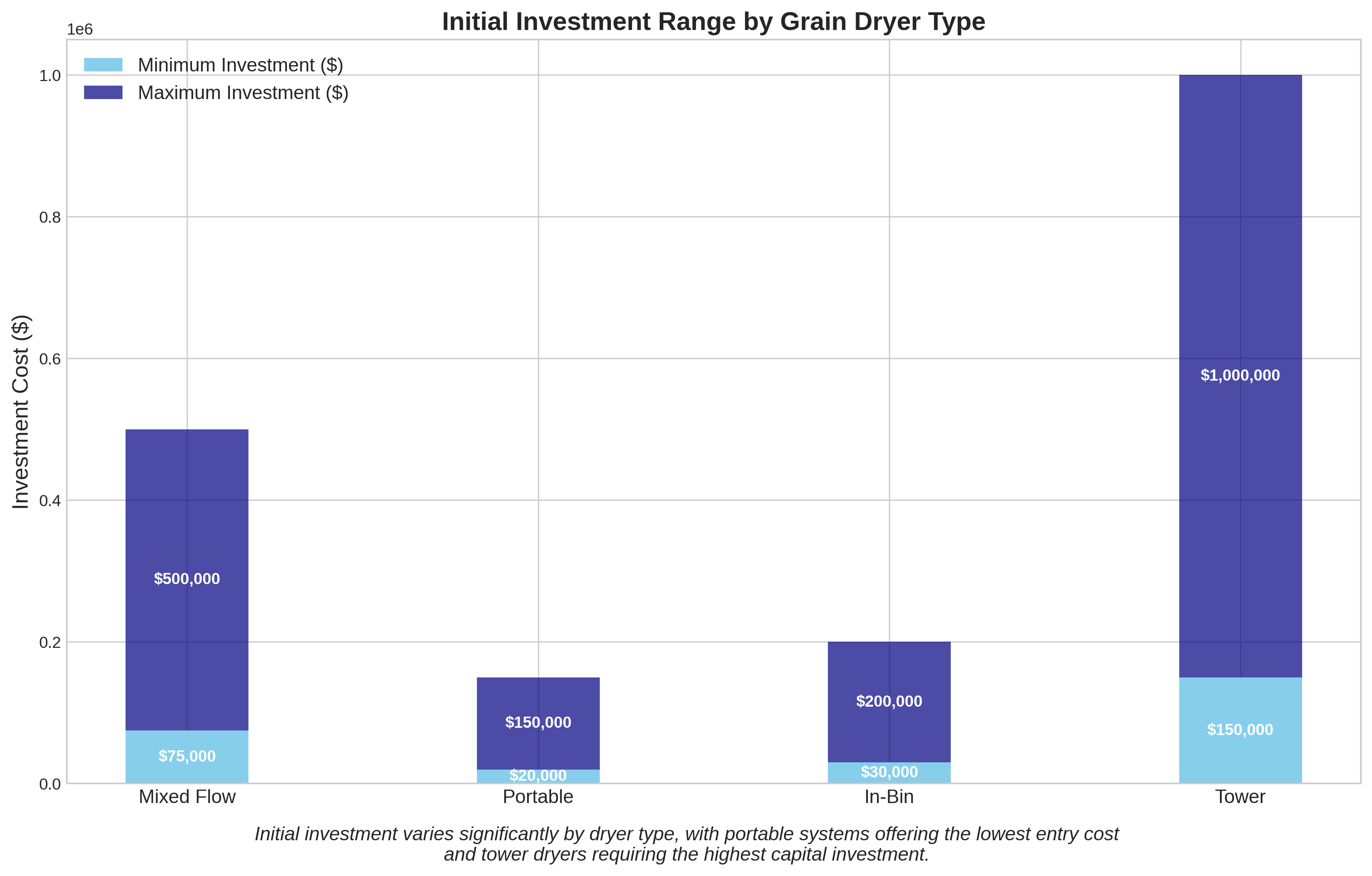
- Small to medium capacity (500-1,000 bu/hr): $75,000-$200,000
- Medium to large capacity (1,000-3,000 bu/hr): $200,000-$400,000
- Large capacity (3,000+ bu/hr): $400,000-$500,000+
Note: Costs exclude site prep, electrical, or grain handling equipment.
Operating Costs
- Fuel (propane): $0.015-0.025 per bushel per point of moisture.
- Electricity: $0.005-0.010 per bushel per point of moisture.
- Maintenance: Approx. 2-3% of initial investment annually.
Dryer Type 2: Portable Grain Dryers
General Principles and Operation
Portable grain dryers are self-contained units designed for mobility. They typically operate as batch dryers, though some offer continuous flow. They are trailer-mounted and include built-in loading/unloading augers.
Energy Efficiency & Costs
Portable dryers generally have lower efficiency due to single-pass airflow and higher heat loss. Initial investment for small units starts around $20,000, reaching $150,000 for large-capacity models.
Dryer Type 3: In-Bin Drying Systems
In-bin systems dry grain within the storage structure using perforated floors and fans. This includes natural-air, low-temperature, and specialized Shivvers Counter-Flow systems.
Shivvers In-Bin Drying Systems
Unlike traditional static in-bin systems, Shivvers uses counter-flow technology where grain flows downward while heated air moves upward. This provides faster drying and better energy utilization.
- Energy Efficiency: Reported fuel savings of 30-40% compared to high-temperature dryers.
- System Options: Includes the Circu-Lator for precision/recirculation and Dri-Flo for high-capacity integration (up to 2,500 bu/hr).
Advantages and Disadvantages for Corn Drying
- Energy efficiency: Uses 30-50% less energy per bushel compared to high-temperature drying.
- Better grain quality: Slower drying produces fewer stress cracks and less breakage.
- Lower operational complexity: Simplifies the transition from drying to long-term storage.
Comparative Analysis
Energy Efficiency Comparison
|
Dryer Type
|
BTU/lb Water Removed
|
Propane (gal/bu/point)
|
Electricity (kWh/bu/point)
|
|---|---|---|---|
|
Mixed Flow
|
1,600-2,200
|
0.015-0.025
|
0.005-0.010
|
|
Portable
|
1,800-2,500
|
0.018-0.030
|
0.003-0.008
|
|
In-Bin
|
1,000-1,500
|
0.000-0.015*
|
0.010-0.015
|
|
Shivvers
|
1,400-1,800
|
0.014-0.020
|
0.008-0.012
|
|
Tower
|
1,400-1,800
|
0.014-0.022
|
0.004-0.008
|
Initial Investment Comparison
|
Dryer Type
|
Small Operation (<50k bu/yr)
|
Medium Operation (50-150k bu/yr)
|
Large Operation (>150k bu/yr)
|
|---|---|---|---|
|
Mixed Flow
|
$75,000-$200,000
|
$200,000-$400,000
|
$400,000-$500,000+
|
|
Portable
|
$20,000-$50,000
|
$50,000-$100,000
|
$100,000-$150,000
|
|
In-Bin
|
$30,000-$100,000
|
$100,000-$200,000
|
$200,000+
|
|
Shivvers
|
$50,000-$150,000
|
$150,000-$300,000
|
$300,000+
|
|
Tower
|
$150,000-$400,000
|
$400,000-$700,000
|
$700,000-$1,000,000+
|
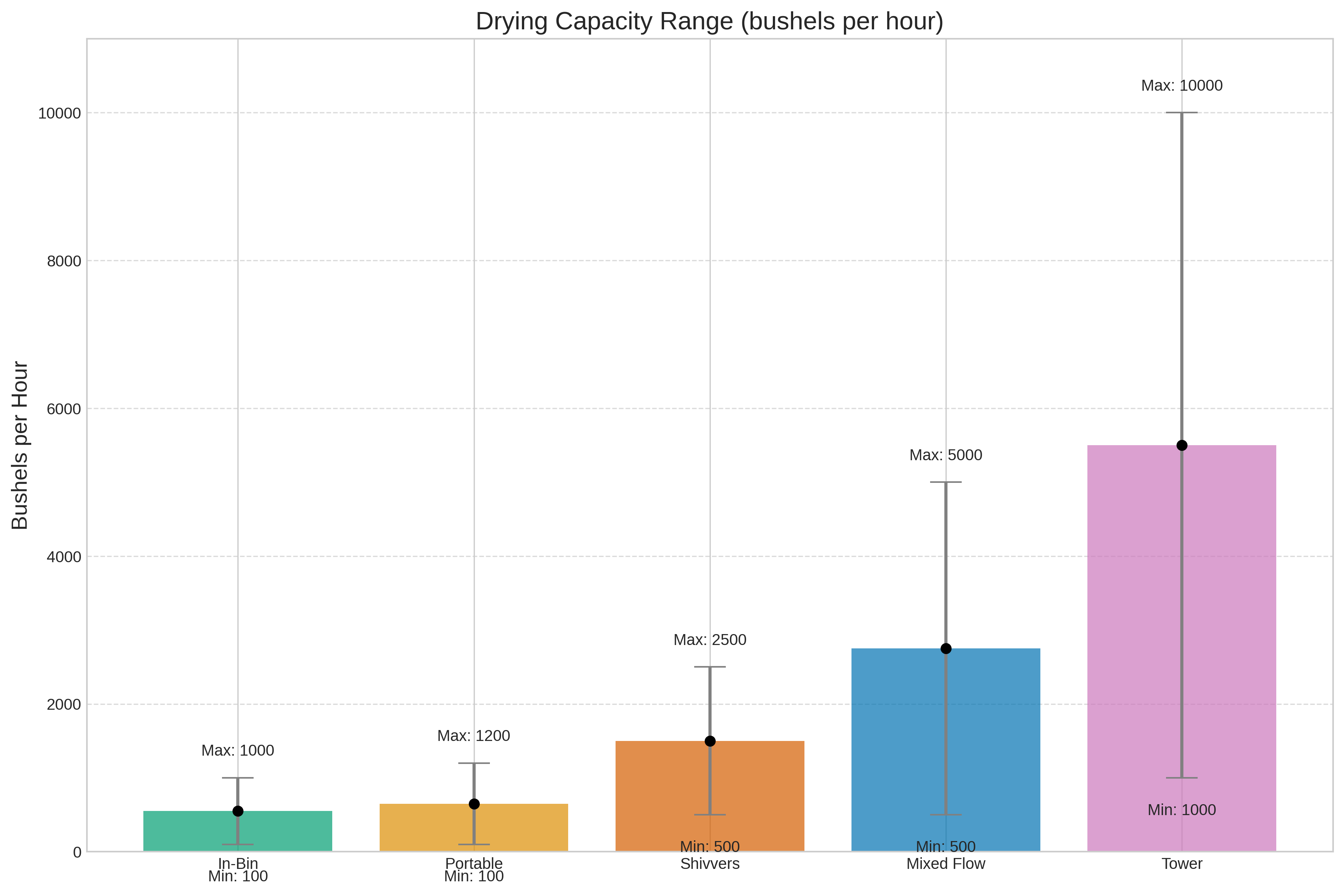
Capacity Comparison
|
Dryer Type
|
Typical Capacity Range (bu/hr)
|
Capacity per $ Invested
|
|---|---|---|
|
Mixed Flow
|
500-5,000
|
Medium
|
|
Portable
|
100-1,200
|
High
|
|
In-Bin
|
100-1,000*
|
Low
|
|
Shivvers
|
500-2,500
|
Medium
|
|
Tower
|
1,000-10,000
|
Medium
|
Grain Quality Comparison
|
Dryer Type
|
Stress Cracks
|
Breakage
|
Test Weight
|
Overall Quality
|
|---|---|---|---|---|
|
Mixed Flow
|
Low
|
Low
|
Excellent
|
Excellent
|
|
Portable
|
Moderate
|
Moderate
|
Good
|
Good
|
|
In-Bin
|
Very Low
|
Very Low
|
Excellent
|
Excellent
|
|
Shivvers
|
Low
|
Low
|
Excellent
|
Excellent
|
|
Tower
|
Low-Moderate
|
Low
|
Very Good
|
Very Good
|
Maintenance and Labor Requirements
|
Dryer Type
|
Maintenance Complexity
|
Annual Maintenance Cost
|
Labor Hours per Day
|
Technical Knowledge Required
|
|---|---|---|---|---|
|
Mixed Flow
|
Moderate-High
|
2-3% of investment
|
0.5-1
|
Moderate-High
|
|
Portable
|
Low-Moderate
|
3-5% of investment
|
1-2
|
Low-Moderate
|
|
In-Bin
|
Low
|
2-3% of investment
|
0.5-1
|
Low-Moderate
|
|
Shivvers
|
Moderate
|
3-4% of investment
|
0.5-1
|
Moderate
|
|
Tower
|
Moderate-High
|
2-4% of investment
|
0.5-1
|
Moderate-High
|
Operation Size Suitability
|
Dryer Type
|
Small Operations (<50k bu/yr)
|
Medium Operations (50-150k bu/yr)
|
Large Operations (>150k bu/yr)
|
|---|---|---|---|
|
Mixed Flow
|
Poor-Fair
|
Excellent
|
Good
|
|
Portable
|
Excellent
|
Fair
|
Poor
|
|
In-Bin
|
Excellent
|
Good
|
Fair
|
|
Shivvers
|
Good
|
Excellent
|
Fair
|
|
Tower
|
Poor
|
Good
|
Excellent
|
Conclusion
There is no single "best" type of grain dryer in agriculture. The optimal choice depends on the specific circumstances of each operation, including size, financial considerations, existing infrastructure, management style, and local support availability.
For energy efficiency and grain quality, in-bin systems (both conventional and Shivvers) generally excel. For capacity and weather independence, tower dryers are typically superior. For flexibility and lower initial investment, portable dryers offer advantages. For a balance of efficiency, capacity, and grain quality, mixed flow dryers are often preferred.
By carefully considering the factors outlined in this analysis, corn farmers in the Upper Midwest can make informed decisions about which grain drying system provides the best value for their specific operations.
References
- Iowa State University Extension, "Managing High-Moisture Corn"
- University of Minnesota Extension, "Natural-Air Corn Drying"
- Purdue University Extension, "Comparison of Alternative Grain Drying Systems"
- USDA Agricultural Research Service, "Energy Efficiency in Grain Drying"
- Sukup Manufacturing Co., Technical Specifications
- GSI (Grain Systems Inc.), Product Documentation
- Shivvers Manufacturing, System Specifications and Operation Manuals
- Farm Progress, "Choosing the Right Grain Dryer"
- Successful Farming, "Grain Dryer Buyer's Guide"
- AgWeb, "Grain Drying and Storage Costs"
- NewAgTalk Forums, User Discussions on Grain Dryer Performance
- The Combine Forum, User Feedback on Various Dryer Types
- Manufacturer Interviews and Product Demonstrations
- On-farm Observations and Operator Interviews