
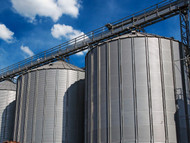
The Importance of Grain Bin Storage
Jun 8th 2026
The priority of grain storage in agriculture determines whether farmers protect crop quality, limit losses, and capture profitable market opportunities. When farm operations invest in purpose-built grain bin storage, they safeguard grain from moisture, pests, and temperature swings that cause spoilage and grade loss.
The efficacy of modern storage systems also help answer a fundamental question in agricultural economics: What is the importance of storage in agriculture for food security and rural incomes? Effective grain storage bridges the gap between harvest and consumption, stabilizes supplies, and allows farms and supply chains to respond to volatile global markets.
At the farm level, on-site bins reduce bottlenecks, support earlier harvest, and improve labor and equipment utilization. Across the value chain, high-quality storage underpins food safety standards, export reliability, and long-term grain value preservation.
Why Grain Storage Is a Make-or-Break Factor After Harvest
Grain remains highly vulnerable in the hours and days after harvest because respiration, residual field moisture and warm temperatures all accelerate spoilage processes. Without protection, even short exposure to rain, high humidity or temperature swings degrades test weight, increases broken kernels, and creates ideal conditions for mold and insects. That vulnerability explains the importance of grain storage as the critical second phase of the harvest.
Right after the harvest, unprotected grain piles or overloaded trucks trap pockets of warm, moist grain. Microbial activity quickly generates hot spots that spread damage outward. Those early losses rarely reverse, so quality discounts and weight loss show up later at the elevator or processor as direct revenue cuts.
Purpose-designed grain bins from providers such as Grain Handling Direct give farmers an enclosed, engineered environment where they manage temperature, moisture, and airflow instead of leaving grain exposed to weather and pests. Where do farmers store their crops? For supply chain analysts and policy makers, the answer points to a central food security question, rather than a mere logistics detail.
The Real Cost of Poor Grain Storage
Poor storage causes losses in three ways:
- Physical weight loss
- Quality downgrades
- Hidden operational costs
Spoilage converts starchy grain into carbon dioxide, water and heat, which burns sealable weight off the inventory. Mold growth, insect damage, and localized moisture migration create grain masses that no longer meet contract specifications, leading to grade discounts or outright rejection.
Economic studies on post-harvest systems show that on-farm storage failures translate into lower net farm income and higher price volatility for consumers. Even small percentage losses compound rapidly at a commercial scale. A few percentage points of weight or grade loss across thousands of tons equals tens of thousands of dollars in lost revenue.
In addition, hidden losses arise from extra handling, emergency drying, or additional transport when operators have to move compromised grain to salvage value. Dedicated grain storage systems reduce those direct and hidden costs by keeping grain in marketable condition for longer periods.
Grain Bins as Controlled Storage Environments
Grain bins function as controlled environments rather than simple containers. They surround the grain mass with a structural shell, an aeration floor, fans, vents, and monitoring equipment that manage heat, moisture, and air movement. By holding grain in a sealed structure with engineered airflow paths, operators maintain more uniform temperatures and moisture content through the entire bin depth.
This control directly supports the importance of grain storage for quality preservation and food safety. Extension research shows that controlled aeration slows insect activity and mold development by keeping grain cool and dry throughout storage. Modern bins often integrate temperature cables, moisture sensors, and automation, which allow managers to make data-driven decisions about when to run fans or adjust settings. Grain bins act as conditioning systems that stabilize grain characteristics until markets, processors, or downstream warehouses need the crop.
Why Airflow Is the Most Important Factor in Grain Storage
Airflow is the center of every high-performing grain storage strategy. When air moves evenly through the grain mass, it breaks up hot spots, removes excess moisture, and levels temperature gradients that would otherwise cause condensation and spoilage. Research from land-grant universities emphasizes that aeration reduces deterioration rates by maintaining cool, uniform temperatures, particularly in the critical top layers and along bin walls.
Without proper aeration, moisture migrates inside the bin as warm air rises through the grain and condenses on cooler surfaces, often near the roof. That condensation wets grain pockets, triggers mold growth and can cause crusting or caking that complicates unloading and increases safety risks.
Purpose-built grain bin fans deliver the airflow volume and pressure needed to move air through dense grain beds, while grain bin vents allow moist exhaust air to escape instead of condensing under the roof.
When operators manage aeration correctly, they maintain grain quality longer and reduce the need for aggressive mechanical drying.
How Grain Storage Impacts Harvest Efficiency
On-farm grain storage transforms harvest from a race against the clock into a more controlled, efficient operation. Storage capacity allows farmers to harvest grain earlier, when field conditions and crop moisture align with agronomic recommendations instead of elevator schedules. An earlier harvest reduces field losses from lodging, weather damage, or wildlife, and it distributes equipment and labor use over a longer window.
When farms rely solely on just-in-time hauling to elevators, trucks, combines, and augers often sit idle in lines, which wastes fuel and labor. Adequate bin capacity eliminates those bottlenecks because grain flows quickly from the field into on-site storage.
Integrated drying systems remove excess moisture at the farm instead of forcing reliance on commercial dryers with higher fees and less control. By decoupling harvest from immediate transport and sale, storage capacity raises effective fieldwork hours and lowers per-bushel harvesting cost.
Storage Flexibility and Market Timing Advantages
Storage directly supports marketing strategy as much as agronomy. Spot prices at harvest often fall because supply floods the market, then recovers in later months as stocks tighten and buyers compete for available grain. When farmers hold grain safely in bins, they time sales to capture seasonal price strength or favorable basis movements instead of accepting harvest-time lows.
Analysts frame this advantage as storage turning grain into a financial asset with embedded optionality. Operators evaluate carrying costs, including interest, shrinkage, handling, and energy, against expected price gains. Well-managed bins also generate positive returns on that storage spread. Strong storage capability also improves a farm’s leverage with buyers because the operation no longer faces immediate pressure to sell into weak bids. In volatile global markets, that flexibility supports farm profitability and broader price stability along the supply chain.
Reducing Waste and Preserving Grain Value Over Time
Effective storage reduces waste by lowering losses from spoilage, pests, and handling damage. International food agencies consistently identify improved post-harvest grain storage as one of the most cost-effective interventions for boosting usable food supplies without expanding planted areas. By managing temperature and moisture, well-aerated bins slow biological activity that would otherwise convert grain into heat and carbon dioxide.
Long-term storage introduces additional risks, including caking, inspect population build-up, and structural issues, but proactive management mitigates them. Extension guidance recommends regular monitoring of grain temperatures at multiple points, inspection for crusting or bridging, and fan operation during suitable weather conditions to maintain cool grain throughout the bin.
Over months of storage, stable conditions preserve test weight, color, and milling or processing qualities, which ultimately sustain higher sale grades and values. For food security experts and warehouse managers, those preserved qualities mean less waste in downstream cleaning and processing and more consistent outputs for mills, feed manufacturers, and exporters.
Why Grain Bin Storage Is Essential for Modern Farming Operations
Modern agriculture now operates at scales and complexities that demand robust grain bin systems. Yields per acre rose over recent decades in major producing regions and farm sizes expanded, which pushes millions of additional bushels through existing storage infrastructure. Grain bins form the backbone of that infrastructure on farms, linking harvest equipment, grain storage, grain bin fans, grain bin vents, and drying systems into a coordinated system.
At the supply chain level, well-designed bin networks support traceability, consistent quality control, and compliance with food safety regulations that govern domestic and export markets. Commercial operators and cooperatives rely on standardized storage practices to maintain grain characteristics that processors and global buyers require.
The importance of storage in agriculture is linked to engineering decisions about bins and aeration and to long-term operational success and risk management. Where farmers store their crops increasingly determines how efficiently they move grain from the field to the final buyer and how resilient they remain in the face of climate and market shocks.
Operators who plan to upgrade or expand their storage systems benefit from working with specialized partners such as Grain Handling Direct that design integrated handling, drying, and storage solutions matched to specific crops, climates, and capacity needs.
That strategic investment strengthens farm profitability, reinforces food safety, and supports stable grain flows from local fields to global markets. To evaluate what a customized grain bin system could deliver for your operation’s efficiency, risk profile, and marketing flexibility, contact us and start building storage that protects crop value year after year.